

Why Don’t Computers Sleep?
Exploring the Difference between Minds and Machines

After a long and exhausting day of task switching, writing, barely having enough time to do one of my hobbies before the sun sets. If I’m lucky, I get an hour of good TV, which is hard to come by in the age of streaming. Then my mind begins to fog, my eyelids get heavy, and then a crazy night of dreaming that gets instantly erased before I wake up the next day. Only then do I realize that I’ve left my TV on all night and it’s still playing. Come to think of it, the TV has been on all night and it’s doing information processing just like I am. Like my mind, it’s burning energy constantly. Why doesn’t it need to sleep? Maybe it’s on a smaller scale than my brain, but still, shouldn’t they need to sleep eventually?
Well, no, obviously, because they are plugged in. They get their energy fed to them constantly, all the time, allowing them to run forever. I’m more like my phone, a wireless device that has a battery, and that battery runs lower and lower every hour, and eventually, I need to sleep just how eventually my phone needs to be plugged in.
But that’s a misconception.
Sleep is not a kind of charging. The real way we “charge” is through food, air, and water—the energy sources that keep us alive. The analogy between sleeping and plugging in a phone only seems right at first glance. But when you look closer, the difference becomes obvious.
When you plug your phone in, energy flows from a power plant into the device. The plant converts stored energy—perhaps from burning oil—into usable electrical energy, pushing electrons through circuits to restore the battery to its charged state.
Your body does something similar. When you eat, the food is first broken down by digestion and then stored. The energy stored in the molecules you consume is transferred into adenosine triphosphate (ATP), the biological “currency” that powers your body. These are broken with oxygen to release energy. This is how you get the energy to stay alive but does not explain why we sleep.
The connection between how we get food and charging actually is even deeper than this. Plants use photosynthesis to store the sun’s energy in molecules. Those molecules are eaten by us or by the animals that we later eat and then transformed into energy that powers our bodies. But in the past, marine plants like algae or plant-like plankton often died without being eaten or using their own energy. All this stored energy was buried deep in the earth over millions of years, becoming oil. The same oil that burns to power your home and charge your phone. But if food is how we charge, then what is sleep for?
Why Living Things Sleep
Neither living beings nor machines can simply run indefinitely. Machines require repair; otherwise, they break down. Living things also need repair to not break down, and this requires downtime.
For a long time, scientists have been trying to figure out exactly what the purpose of sleep is, and they have come up with many possible theories. Each one of these theories explains one piece of the puzzle.
One early theory was the inactivity hypothesis: that sleep evolved to keep animals safe during the night, when visibility was low and predators were most active. While this may have shaped when we sleep, it doesn’t explain why sleep is biologically essential. After all, sleep deprivation doesn’t just make us tired—it leads to memory loss, hallucinations, and even death. Evolution wouldn’t make something that is optional that dangerous.
A related theory claimed that sleep evolved to conserve energy. But this, too, falls short. The reduction in energy use during sleep is surprisingly small, and eating more doesn’t let us sleep less. Clearly, sleep serves a more profound purpose than simple conservation.
The Brain at Work
Another idea is that sleep allows the body to perform repairs—muscle, bone, and tissue healing work better during sleep. But where this theory really excels is in the Glymphatic System, a waste removal system for neurotoxins that accumulate during the brain’s waking hours. The human brain uses about 25% of the body’s energy, and that intense activity creates a lot of waste. This system clears it out and is most active during the night—a strong clue to why sleep is necessary. This suggests that just as computers create waste heat the brain creates a different kind of waste so instead of a cooling mechanism the brain sleeps.
It may be more than cleaning, though. Evidence also suggests that memory is a major reason for sleep. During sleep, the brain strengthens important neural connections formed during the day while pruning weaker ones, improving memory and skills. Numerous studies show that poor sleep harms recall and performance, while good sleep enhances them.
Different stages of sleep seem to handle different kinds of memory: deep non-REM sleep stabilizes declarative memory (facts and events), while REM sleep consolidates procedural memory (skills and tasks).
The Library of the Mind
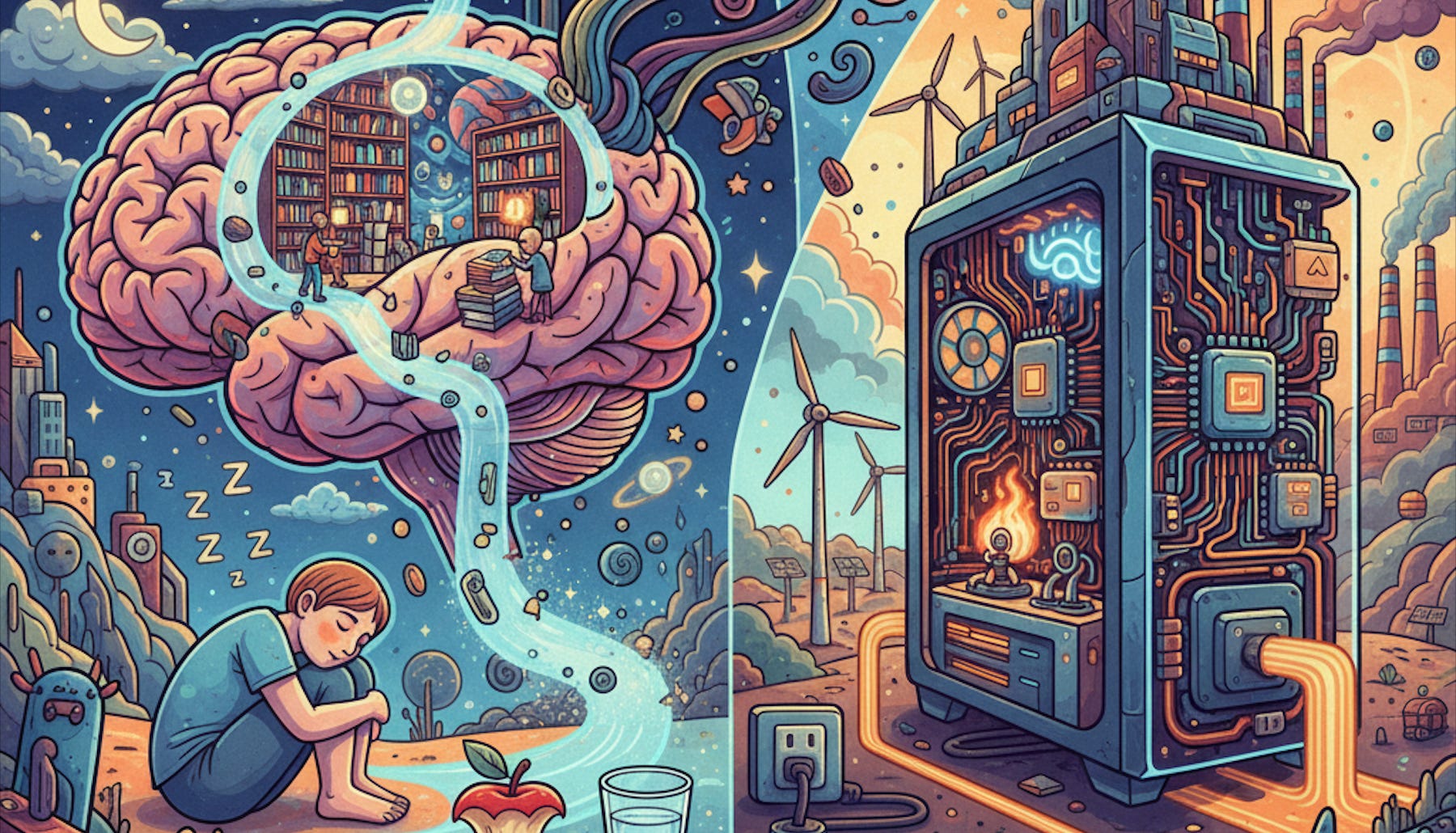
So it seems, there are two primary reasons why sleep is non-negotiable in animals, and they’re deeply connected. Think of your brain like a library full of memories. During the day, the library is crowded—people moving books, adding new ones, making a mess. It’s too chaotic for the librarian to organize anything, just like how your brain is forming new memories and processing experiences while you’re awake. So the library closes at night, just as your brain must sleep. Then the librarian—your brain’s organizing and memory-forming processes—can get to work, placing memories where they belong for long-term storage.
But the librarian can’t do much if the library’s dirty. During the day, customers leave junk everywhere, making it harder to work over time if it isn’t cleaned up. That’s where the janitor comes in, cleaning while the doors are closed—just like the Glymphatic System clearing out waste products from the brain.
The library, like the brain, can’t stay closed forever. It’s an important public building, so it has to reopen. So it schedules maintenance at night, when few people would visit—especially in a time or place with no artificial light, where trying to read would be difficult anyway—and when danger is higher outside, like how staying awake at night in the wild could increase the risk of being attacked. This mirrors the inactivity theory: sleep happens when the brain is least needed and it’s safest to rest. Energy conservation is just a happy side effect because only the librarian and janitor are active, meaning there’s less general wear and tear. And if repairs to the building itself are needed, they’re best done after hours—just like how the body performs physical repair during sleep.
Why Don’t Computers Sleep?
Machines don’t generate biological waste that must be flushed. They create waste heat instead. They don’t have memories that need emotional consolidation or experiences that require integration into a continuous self. A computer can process information but it doesn’t need to worry about survival.
Sleep, then, isn’t about energy at —it’s about maintenance. It’s what biological minds, not electrical machines, require.
The necessity of staying still to avoid notice would create a good time to carry out other tasks, so that could be the starting point.
Also if you do not reboot your computer, eventually bad things will happen. I remember once when we were told to hop through hoops for weeks until finally that stopped working, and they had to reboot the servers. They found they had GIGABYTE LOGS, and decided they needed to schedule reboots.