

History of Quantum Computers
The True Universal Computer

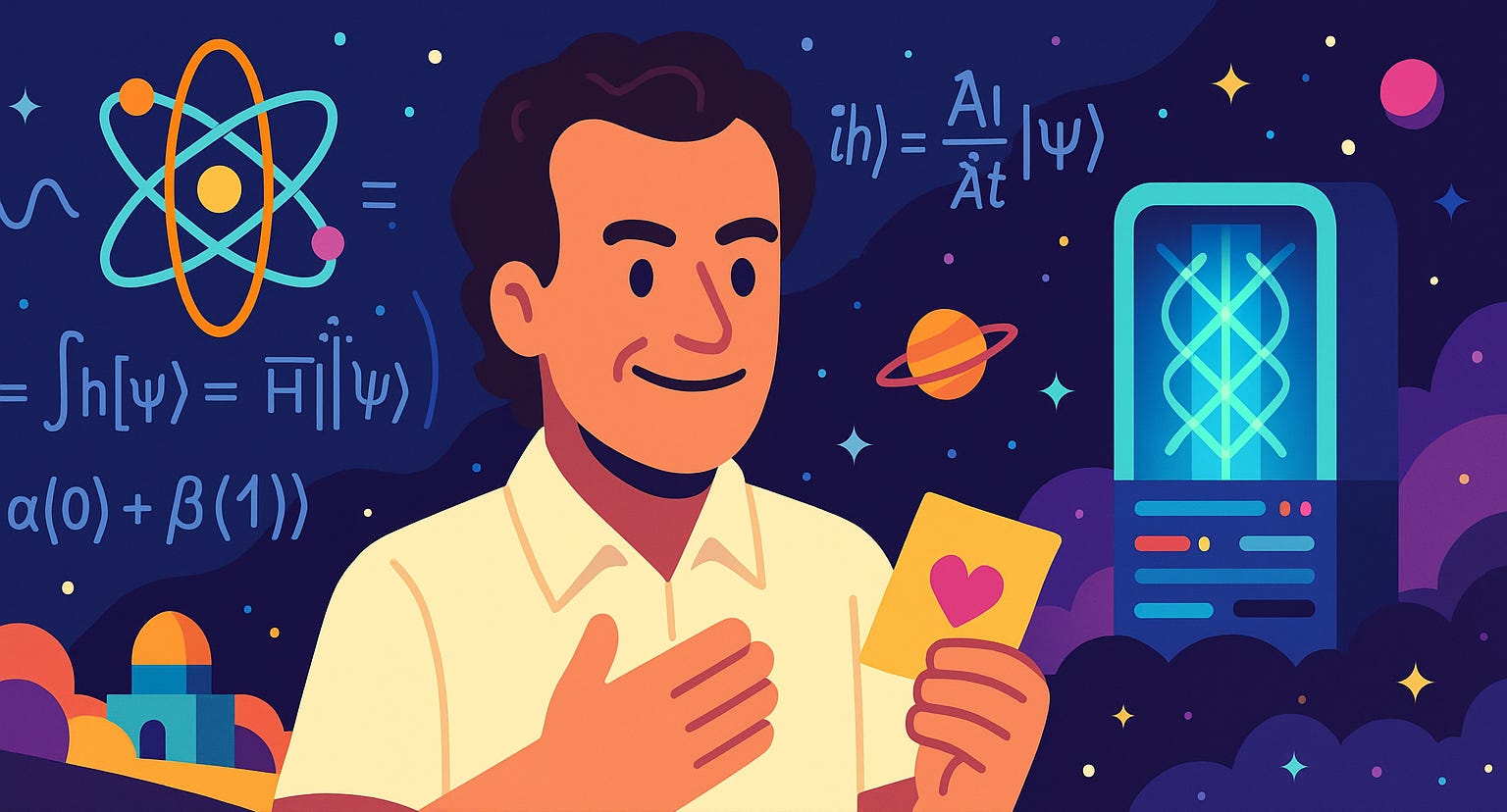
Amid the intense secrecy of the Manhattan Project, the young Richard Feynman, despite the importance of the work, also maintained a sense of humor. He would pull pranks on fellow physicists, mainly to show the poor security, by accessing safes and leaving whimsical notes behind. The main reason he was there was to pay for his wife’s medical treatment, using nearly all of his earnings to help fight her diagnosis of tuberculosis, a fatal disease at the time. When he found out she was getting worse, he rushed to see her and spent hours with her until she passed away at 25.
The Quantum Computer
Afterward, Feynman became increasingly focused on his work, becoming one of the experts on quantum physics. One of his biggest ideas was that if we wanted to better understand how atoms and chemicals react, a computer that was based on quantum machines would be the most efficient. This was the beginning of the quantum computer.
Later, in 1985, building on Feynman’s ideas, David Deutsch wrote the essay “The Universal Quantum Machine.” In this paper, he not only demonstrated that a quantum computer could solve some problems faster than a classical computer but also that, because a quantum computer can exist in a superposition of 1 and 0 as well as purely 1 or 0, classical computing is actually a subset of quantum computing. This discovery is like the Copernican revolution for computers. We realized that what we thought was the basis of computing was actually a human-centric idea and that what the universe means by computation is quantum computation.
While the original idea of quantum computation, to simulate quantum physics more efficiently remains one of its most useful cases, we have discovered other areas where it can speed up processes.
Better Algorithms
In computer science, we categorize problems by how complex they are to solve based on the size of the input. Some problems scale gently, but others, like finding the prime factors of a large number, grow at a staggering rate. The promise of a quantum computer is not to solve different problems but to move some of them into a lower complexity class. Although quantum computers can compute all answers in parallel, the problem is that when measured you only get one random answer. The real key to quantum computing is choreographing ways for the incorrect answers to cancel each other out, lowering the probability that you will read them.
We’ve only discovered a handful of these algorithms. One of them, discovered by Peter Shor, can find the prime factors of large composite numbers much more efficiently. This is the idea that risked breaking RSA encryption, which is currently the most widely used encryption on the internet. Bad actors are already collecting encrypted information now, hoping that in the future they will have access to a quantum computer to decrypt it. Fortunately, we have begun creating new ways of encrypting data (post-quantum cryptography) that we believe quantum machines cannot easily break. More positively, quantum computing could help unlock everything from new medicines to the creation of better AI.
Quantum Biology
We aren’t the only ones that use quantum machines to our advantage. For a long time, it was unknown how birds knew which direction south was. Experiments suggested that birds could somehow see the Earth’s magnetic field. The leading theory today involves quantum effects: a bird may keep an electron in superposition for a short period of time, making it sensitive to the Earth’s magnetic field. This signal is then sent to the brain, allowing the bird to perceive the field.
This remarkable discovery began one of the most interesting fields: quantum biology. Scientists now think quantum effects may also play a role in photosynthesis and perhaps even in smell. The important part is that this shows evolution can allow biological systems to take advantage of quantum mechanics if it is useful for survival.
Combining this with what we know about quantum computation mainly that it can be much more efficient for solving certain problems, it’s possible to imagine that if we, as biological creatures, ever faced evolutionary pressure to process information as fast as possible, our brains might develop small quantum circuits.
Perhaps if we ever want to build truly conscious machines, they will need to be implemented on a quantum computer, because certain computations required for awareness might simply be too fast or too complex for a classical one.
What The Universe Is Telling Us
One question that is still at the heart of quantum mechanics and important for understanding the world we live in is: what is quantum mechanics trying to tell us?
The main issue is the measurement problem, which, simply put, is how come systems behave according to the rules of quantum mechanics in many different states but when we look, it suddenly snaps to a single state.
Also, even if you could store one piece of classical information on every particle in the universe, you would still only be able to represent the state of about 300 qubits. Furthermore, quantum decoherence suggests that the information of the qubit gets smeared out and entangled with everything. Deutsch himself believes that quantum computers only make sense in light of the many-worlds interpretation of quantum mechanics, the idea that every possible outcome in a superposition is realized somewhere. The issue with this interpretation is that it cannot explain the fact that there are different probabilities for different outcomes.
There are various other interpretations, GRW, Bohm mechanics, Quantum Bayesianism, Relational Quantum Mechanics, to name a few. Each of them also has its own problems. The most common is the Copenhagen interpretation, which can be thought of as physicists saying we don’t need to explain what happens, simply explain the readouts on machines. It’s less of an interpretation because it fails to explain why the state changes when we look, but rather just says it does.
Feynman famously said, “No one truly understands quantum mechanics,” but to him, this wasn’t a failure at all. Maybe the existence of mystery isn’t a flaw but a fundamental part of existence, a recognition that the universe holds more interpretations than our minds can understand. Feynman’s understanding of quantum physics was primarily about understanding that everything is connected in every possible way; we just don’t see it.
Later he remarried and had a family, and after his death, a letter he wrote to his first wife was found, written over a year after she passed away. In it, he speaks of still loving her, wishing they could’ve spent more time together, and the strangeness of her not being around. He kept his humor, ending the letter with, “P.S. Please excuse my not mailing this but I don’t know your new address.”
Perhaps quantum mechanics isn’t something we can make sense of. We already live in a strange, complex world—a world where a physicist can help build an atomic bomb, dream of quantum computers, and write a love letter he’ll never send. In that sense, the mystery of quantum mechanics and the mystery of love may not be so different: both remind us that connection, not certainty, is what binds the universe together.
Robert, I really enjoyed how you tied Feynman's deeply human story into the profound mystery at the heart of quantum mechanics. The distinction you drew between simulating quantum systems and reshaping what computation itself means really resonated. One area that intrigues me unexplored here is how quantum error correction might shift not just the hardware but the entire architecture of future algorithms.
From a VC lens, the real test for quantum tech will be commercialization through scalable service models not just selling compute but offering problem-solving as a subscription. The edge comes when quantum services deliver unique value beyond classical solutions, especially in domains like encrypted cloud or pharma modeling. What’s your take will the big leap come from vertical integration or platform style quantum marketplaces?
Quantum has the potential to change a lot of things in many sectors. But now, the main challenge is to turn this science into real-world applications. Two European companies are doing it: Quantinuum and IQM
https://thebigbyte.substack.com/p/europe-quantum-technology-iqm-quantinuum