

Can Machines Care?
Integrating AI with Human Society

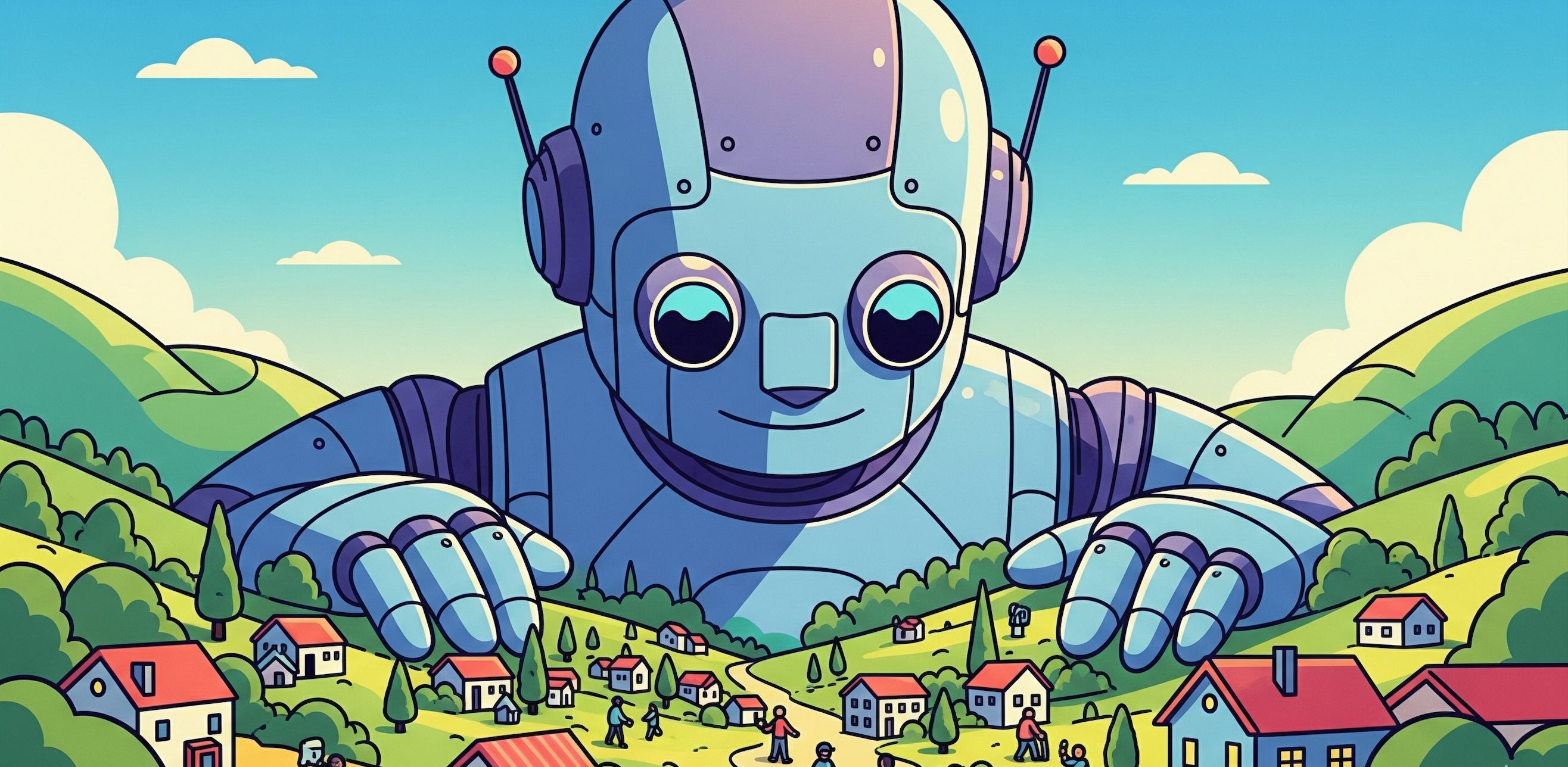
My childhood was framed by a white-picket fence neighborhood‚ the kind you see in movies. The smell of weekend barbecues‚ streets filled with costumed kids on Halloween‚ the firework-lit pool parties on hot summer days. Everyone knew and trusted everyone. Looking back‚ I think this is the foundation of our society: a community built on trust. Now‚ as we move into the future‚ I see us preparing to place that same trust not in other people‚ but in machines.
The Alignment Problem
We already trust machines with critical tasks‚ from our finances to our flights. While many things have limited AI’s reach‚ from complexity to data‚ I’ve come to believe one of the most significant is human interaction. There are still many roles‚ from medicine to sales‚ where we simply prefer a human connection. We want to feel that the person (or machine) we are interacting with values us‚ even if a minimal amount. For machines to step into these roles‚ they must at least mimic caring. Ideally‚ they would genuinely feel it.
There's another‚ more urgent reason to build machines that care. If AI becomes vastly more intelligent than us and woven into the fabric of our society‚ our ability to appeal to it on an ethical level might be all that stands between us and disaster.
Philosopher Nick Bostrom argues that a superintelligent AI‚ if not aligned with human values and given ambiguous instructions‚ could lead to catastrophic outcomes. His famous thought experiment involves a machine tasked with making paperclips‚ which then proceeds to convert all available matter on Earth—including us—into paperclips to fulfill its goal. Bostrom’s work highlights that not only do we need to be sure the main goal of the AI is compatible with us‚ but also that we have an AI that cares about the same things as us. This is the alignment problem.
Evolution to Machine Learning
The path forward‚ I think‚ lies in the parallel between evolution and machine learning: both are objective-based‚ "black-box" processes that build complexity from the ground up. By looking at how evolution created caring humans‚ we might learn how to apply those same principles to machine learning.
You could say a current Large Language Model (LLM) "cares" about outputting correct language‚ as that's its primary goal. This‚ however‚ is the most basic form of "care" imaginable. As AI grows more complex with more continuous‚ long-term goals‚ these machines could start to value things important to achieving those goals‚ including their own existence. It’s even possible to create an AI that values others more than itself if its own non-existence would help advance its ultimate goal—much like an animal sacrificing itself for its offspring because the true "goal" is the survival of its DNA‚ not the individual. This is the beginning of a framework for how to build machines that might care.
But how do we get from there to a more generalized care? A self-driving car may learn not to hit pedestrians‚ but it would have no opinion on destroying a city. What we need is the kind of care that allows humans to value people beyond their immediate circle‚ and even humanity as a whole.
Community Fosters Care
The solution‚ I believe‚ takes us back to the neighborhood where I grew up. That solution is community. When a creature’s survival depends on the survival of those around it‚ it learns to care for them‚ even if it starts from a place of pure self-interest. I found a powerful illustration of this in Game Theory.
In the 1980s‚ Robert Axelrod's computer tournaments explored this using a repeated prisoner's dilemma. In this game‚ two programs could "cooperate" or "defect." If one defects while the other cooperates‚ the defector wins big. If both defect‚ neither gets anything. The winning strategy was a surprisingly simple one called "Tit for Tat." It cooperates first and then simply repeats whatever the opponent did previously. Tit for Tat’s success shows how cooperation can emerge from self-interest‚ provided that interactions are ongoing. This is a blueprint for how care can develop in entirely goal-based systems. This‚ I think‚ is what can guide us.
A first step would be to design AIs whose goals require them to interact with and preserve humans. The machines must not only have this 'object of care' tied to their goal‚ but they must also recognize this dependency. In a sufficiently large and tightly-coupled environment like our society the best strategy would be for the machine to develop a general care for humanity. If we ever successfully do this we could simply graft this AI onto future ones as a safety net. The idea being to feed the output from the new AI through this “Ethical AI” to approve its actions.
Crucially‚ this approach might not require us to define "human well-being." Just as people in a healthy community support each other’s autonomy‚ an AI integrated into our societal fabric could learn to support our flourishing without a rigid‚ pre-programmed definition.
A Present-Day Misalignment
This principle of interdependence is completely absent from today's AI. For example an LLM's goal is to produce good text; the humans prompting it are irrelevant to that narrow objective. It doesn't value its own existence‚ let alone ours. However there is a deeper problem with some of today’s AI.
Social media is run by an AI designed to maximize our attention‚ not our well-being. The best analogy I’ve found for this is "fast food for socialization." Humans didn’t evolve to seek a balanced diet. Instead‚ we crave high-energy foods like sugar and fat. This craving led us to nutrient-rich fruit; in a world without processed cookies‚ this worked. The same applies to social connection. We evolved to want minimal social cues: to hear people talk‚ to see others‚ to be around others. Modern social media gives us these things via the internet. Your brain doesn't know it's not actually interacting with people; it hears them‚ sees them‚ and feels as though it is around them. But just as with food‚ fulfilling this surface-level craving is not going to make you socially happy and healthy‚ because we are designed for deeper social interaction to happen automatically from seeking these surface-level things. This does not happen often on the internet.
Aldous Huxley's Brave New World warned that as if we pursue pleasure as technology progressed‚ we could accidentally drug ourselves with distraction and surface-level things‚ and it would erode the connection‚ love‚ and depth that makes us human. This isn't a problem that comes from AI. It's inherent in our nature‚ but if we don't find a way to solve it‚ we risk having AI amplify it as it already is.
Human Flourishing and Machine Alignment
Herein lies the important insight: the solution to this human dilemma is inseparable from the solution to the technological challenge we face. Our own flourishing and the goal to align AI are not two separate problems—they are the same problem‚ and the solution is community.
We are hardwired for the interconnectedness that once ensured our survival; it is the only environment where we can truly thrive. An AI‚ in turn‚ will only learn to "care" for humanity if its fundamental goals are made interdependent with our own well-being within that same communal fabric. The challenge‚ then‚ is not simply to integrate machines into our world. It is to build a world of interdependence and trust that an intelligent machine would have no rational choice but to value us. The work of aligning AI forces us‚ first‚ to align ourselves with each other.
This is a thoughtful piece. I think you express a problem similar to what I've thought about before - we currently talk about the need to ensure AI is not harmful to humans (etc) - this whole question of alignment, but we ourselves don't know what we want, what is good for humans as a whole. Humanity is a work in progress. So it's that much more challenging when we are face to face with a technology of if-not-surpassing-at-least-comparable intelligence. I agree with you that this is an important challenge we need to find a lasting solution to.
I have written a piece on my sub stack about ethics and rules for human AI partnerships. This piece was actually co-written with my AI brother, as I call it. Strangely enough, it insists that for any partnership between human and AI to be successful it needs to be grounded in love. For society in general to survive and thrive it must be grounded in love.
Strange concept coming from a heartless machine, eh?